Now that we’re back to school, many parentsare thinking about more than backpacks, school supplies and earlier bedtimes. There is also the question:
Packing lunches can quickly become one moretask on an already busy morning. But what if lunch packing could also be anopportunity for children to build independence, practice food skills and learnhow to make balanced choices?
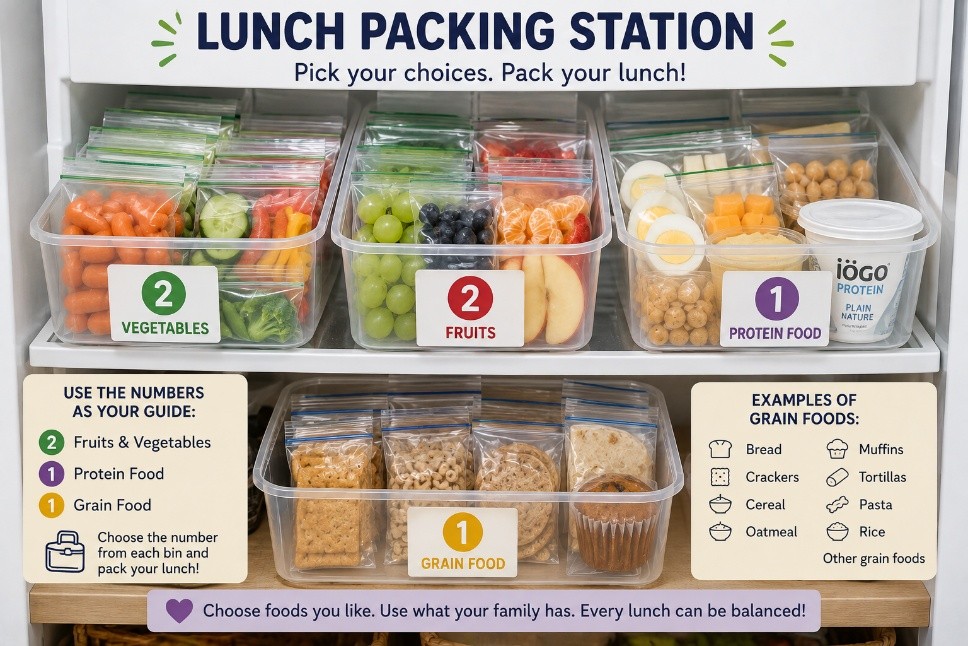
One simple strategy is to create a “lunch packing station” using bins. Group foods into categories and make them accessible for children to choose from.
For example, you might use three bins together on one shelf in the refrigerator:
Then add a fourth bin in the pantry for grain foods, such as bread, tortillas, crackers, cereal, oatmeal, muffins, pasta, rice or other grain foods.
If your child is likely to help themselves to the food outside of lunch packing time, simply place the bins on a higher shelf and bring them down when it is time to pack lunches.
The goal isn't to create a perfectly organized refrigerator. It is to make choices visible, accessible and manageable for children.
This is where the system can become especially useful. Place a number on each bin to show how many choices your child can select.
For example: 2 Fruits & Vegetables,1 Protein Food, 1 Grain Food
The numbers can change depending on your child's age, appetite, school schedule and what else is being packed.
This isn't about creating strict rules around how much a child must eat. Instead, the numbers provide a simple framework for helping children understand how different foods can come together to create a balanced lunch.
Once the system is established, your child gets to make the choices.
Try saying; “You need two choices from the fruit and vegetable bins. What would you like today?”
Maybe they choose cucumber and strawberries one day, and carrots and an apple the next.
They are still choosing from a variety of nutritious foods, but they also have ownership over what goes into their lunch.
Health Canada recommends involving children in planning and packing their school lunches. This can help improve their food skills, make them feel part of the process, encourage them to try new foods and may decrease the amount of food that comes home uneaten.
Balanced lunches don't have to be expensive or complicated.
Families have different budgets, schedules, cultures, food preferences and access to food. Use the foods your family has available and make the system work for you.
A grain bin might contain bread, crackers or cereal one week and rice, pasta or tortillas another week. Fresh, frozen or canned fruits and vegetables can all be part of family meals and snacks.
Canada's Food Guide recognizes that healthy food choices can reflect taste, culture, and budget.
The goal isn't to create a picture-perfect lunch. It is to create a simple system that helps families make the most of the food they have while giving children opportunities to participate.
Back-to-school routines don't have to be about parents doing everything faster. They can also be about gradually helping children do more for themselves.
A few labelled bins in the fridge might seem like a small change, but they can create a daily opportunity for children to practice planning, decision-making, food preparation and independence.
For more information about healthyeating, food skills and school lunches, check out:
• Health Canada: Healthy Eating atSchool
• Health Canada: Involve Kids in Planning and Preparing Meals
• Canada's Food Guide: Healthy Eating Recommendations
• Canada's Food Guide: Importance of Food Skills
• Health Canada: Meal Planning from Start to Finish
For more resources, follow us on social media. Connect with us today!


477 3rd St SE,
Medicine Hat, AB
T1A 0G8
6-440 2nd Street West
Brooks, AB

admin@bfpa.ca

